
YouTube動画のリンク
https://youtu.be/Qolp41YhZPk
目次
Analysis of Consciousness and the Observer Problem: Insights from Shunsuke Oyama
Executive Summary
This briefing document synthesizes the reflections of Shunsuke Oyama regarding the relationship between consciousness, the “self,” and the creation of reality. The central thesis challenges the popular spiritual and self-help notion that the individual ego (the “Me”) is the primary architect of one’s reality. Instead, Oyama argues that the ego functions as an “announcer” or “passenger” rather than the driver.
Key takeaways include:
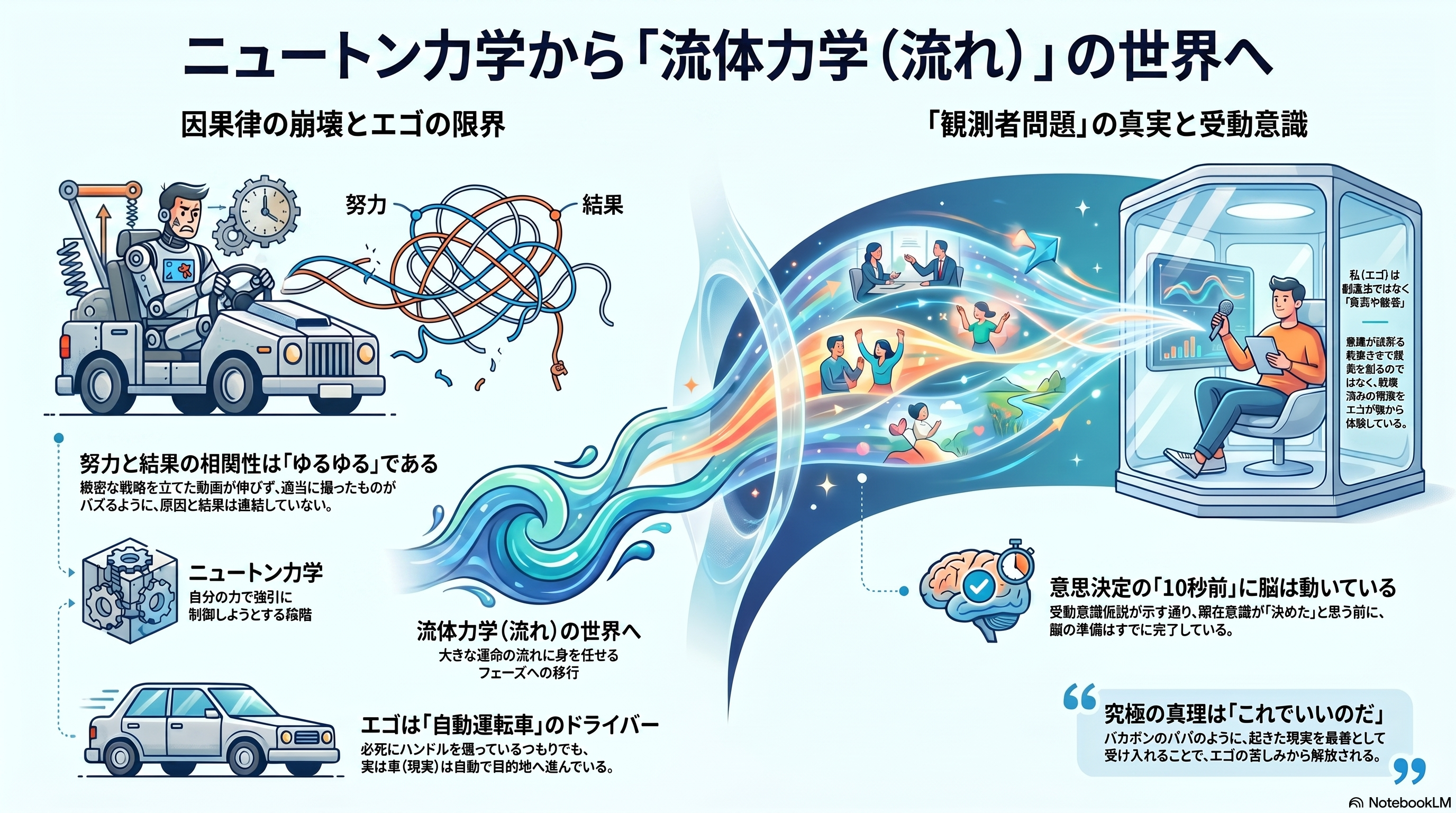
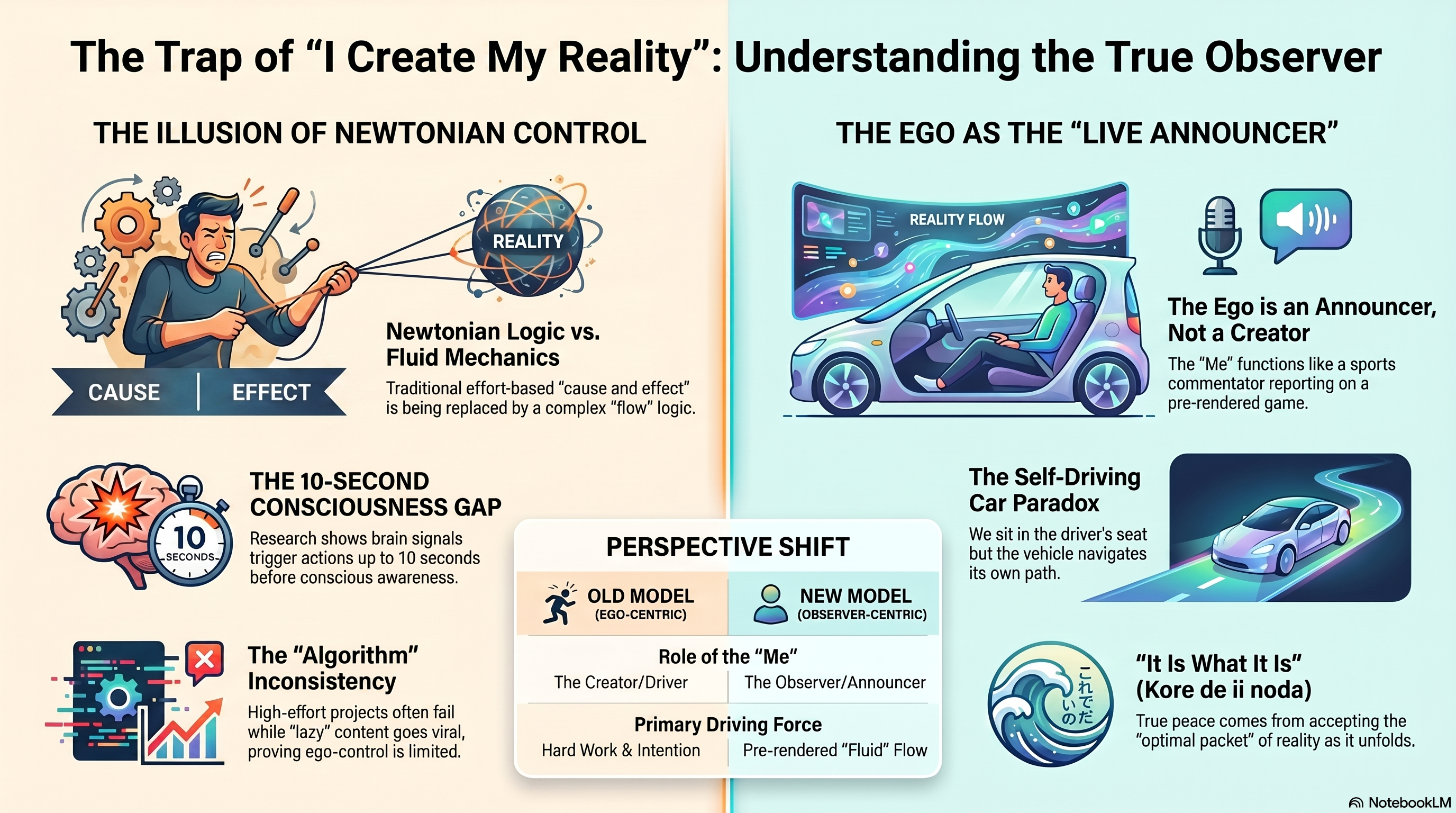
- The Illusion of Agency: Evidence from neuroscience suggests the brain initiates actions before the conscious mind is aware of them, positioning the “Me” as a passive observer of pre-rendered events.
- Newtonian vs. Fluid Mechanics: Reality often transitions from a predictable, cause-and-effect structure (Newtonian) to a “fluid” state where effort and outcome lack linear correlation.
- The Observer Problem Redefined: While quantum mechanics posits that observation collapses the wave function into reality, the entity performing this observation is not the ego, but a deeper, essential consciousness.
- Practical Implications: In business and life, recognizing the “automated” nature of reality can alleviate the friction of the “Hero’s Journey” and move an individual toward a state of acceptance.
The Productivity Paradox: A Case Study in Creation
The document outlines a period of intense productivity for Shunsuke Oyama during May, despite significant business challenges involving debt restructuring and bank negotiations. This period serves as the experiential foundation for his insights into “Creation Energy.”
Key Achievements in a Single Month
- Web Development: Rebuilt a company website from scratch in two days to better align with current messaging, bypassing a 20-year-old legacy system.
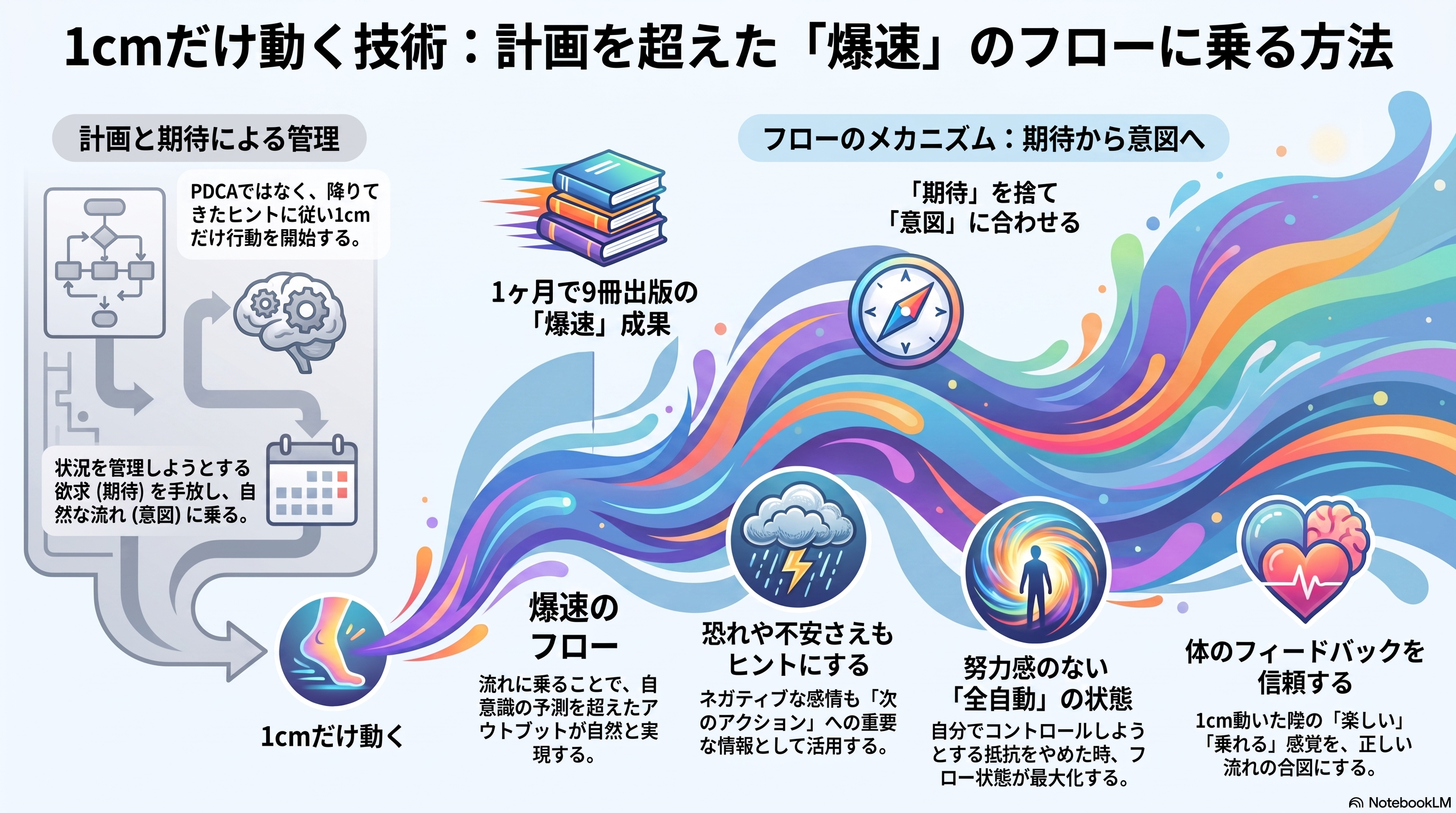
- Authorship: Wrote and released five to seven books in a single month (including English translations), covering topics from English coaching to the “Zero Point Field.”
- Curriculum Development: Completed an advanced English curriculum that had been stalled for ten years, finishing it in a three-day “surge.”
The Shift from Reaction to Creation
Oyama notes that while his company faced financial peril, he avoided the typical “Fight or Flight” response. Instead of reacting to bad numbers with fear, he channeled that energy into “the alchemy of fear,” converting the pressure into creative output.
The Disconnect Between Effort and Outcome
A significant portion of the analysis focuses on the breakdown of “causality” in modern business environments, specifically within digital platforms.
Observations from Google Ads and YouTube
Oyama identifies a lack of correlation between planned effort and results:
- Advertising Inconsistency: Increasing budgets or optimizing keywords in Google Ads often leads to decreased impressions or clicks, defying standard marketing logic.
- Content Virality: Highly planned, high-value YouTube videos often underperform, while “low-effort,” unscripted, or “embarrassing” videos frequently achieve hundreds of thousands of views.
- The “Loose” Linkage: He concludes that the link between “Cause” (effort/input) and “Effect” (result/output) is far more fragile and “loose” than generally assumed.
Re-evaluating the “Observer Problem”
The document explores the “Observer Problem” through the lens of quantum mechanics and its misinterpretation in spiritual circles.
The Scientific Context
The source references several foundational concepts in quantum physics:
- Double-Slit Experiment: Demonstrates how observation causes wave-like probabilities to collapse into particles (reality).
- Schrödinger’s Cat & Copenhagen Interpretation: Used to illustrate the state of superposition and the role of the observer in determining a state.
- Von Neumann’s Theory: Highlights the idea that “ego” or consciousness is what collapses the wave into reality.
The Trap of the “I”
The briefing warns against the trap of believing that the “Me” (the ego, based on memory and thought processes) is the one determining the collapse of the wave. Oyama asserts that if the “Me” had the power to collapse the wave, individuals would have perfect control over their lives. The reality of consistent failure or unexpected outcomes suggests that the “Me” is not the decision-maker.
The Passive Consciousness Hypothesis
To support the idea that the ego is a secondary processor, the document cites neuroscientific research regarding the timing of consciousness.
Evidence of Pre-determined Action
- Benjamin Libet’s Experiments: Showed that the brain’s electrical signals for movement occur seconds before the conscious mind “decides” to move.
- Max Planck Institute (2012): Suggested that the lag between brain activity and conscious awareness could be as long as ten seconds.
- The “Announcer” Metaphor: Oyama likens the ego to a sports announcer providing a play-by-play (實況中継). The announcer describes the game but does not play it.
The Role of the Ego (The “Me”)
- Data Aggregate: The ego is defined as a collection of memories, thoughts, and emotions—essentially a “Default Mode Network” (DMN) that processes data.
- The Automated Vehicle: Life is compared to sitting in the driver’s seat of a car only to realize it is an automated vehicle. The ego’s job is to experience the “thrills and chills” of the ride, not to steer.
Evolutionary Phases of the Self
The document describes a transition in how one interacts with reality based on their stage of development.
| Phase | Framework | Characteristics |
| Early Stage | Newtonian Mechanics | Belief in cause and effect; effort equals results; the “Hero’s Journey.” |
| Middle Stage | Integration & Alchemy | Identifying beliefs/notions; neutralizing fear; shifting energy toward creation. |
| Advanced Stage | Fluid Mechanics | Realizing the “Me” does not collapse waves; accepting the “Automated Driving” of reality. |
Essential Quotes and Philosophical Conclusions
The following quotes capture the incisive tone of the analysis:
- On the Illusion of Control: “You think you are choosing, but the revelation is: ‘You aren’t the one collapsing the wave function.’”
- On the Nature of the Ego: “The ‘Me’ is just an announcer. It’s a broadcaster watching the collapsed wave and reacting with laughter or tears.”
- On Business Logic: “I used to believe in a strong correlation between my actions and results. Lately, I’ve realized this is incredibly loose.”
- The Final Philosophy: Oyama references the character Bakabon’s Papa and his catchphrase, “It is what it is” (Kore de ii noda). He suggests that every “packet” of reality, even if it looks bad to the ego, is part of an optimal data sequence already prepared for the individual.
Conclusion
The document concludes that the belief “I am creating my reality” is often a trap for the ego. While reality is being created and observed, the “I” that does so is not the self-conscious ego. True liberation comes from acknowledging the “automated” nature of the narrative and fulfilling the role of the observer with acceptance, even during high-stakes “events” like business restructuring or personal crises.
The Reality-Creation Trap: Why Your Ego is Just a Commentator in Your Own Success
1. The Frustration of the Hard-Working Creator
In high-stakes business, we are sold the “Newtonian” myth: that if we apply a specific force of effort, we will receive a predictable, linear reaction in the form of success. Yet, seasoned entrepreneurs eventually hit a wall where this logic fails. Why do our most meticulously planned campaigns often flatline, while a “shameless,” off-the-cuff decision occasionally yields a massive ROI?
Shunsuke Oyama recently navigated this paradox during a period of extreme professional duress. While managing high-stakes bank debt rescheduling (known in Japan as risuke) and securing bridge loans to keep his company afloat, he experienced a staggering burst of productivity—7 books written in a month and the completion of a decade-old project in 72 hours. This suggests that “creating your own reality” isn’t about control; it’s about understanding who is actually pulling the strings.
2. Takeaway 1: Productivity is a Flow, Not a Force
In May, Oyama’s output reached a level that defies standard time-management logic. He produced five Japanese books, two English translations, a new company website in 48 hours, and finalized an educational curriculum that had been stagnant for ten years.
This wasn’t achieved by white-knuckling through the stress of potential bankruptcy. Instead, it was an “Alchemy of Fear.” When the ego’s friction coefficient is high due to crisis, the body usually defaults to a “fight or flight” response. Oyama redirected this survival energy into “creative ignition,” shifting from a state of paralysis to one of pure flow.
“The energy that manifested as fear was successfully converted into the energy of creation… an alchemy where fear becomes the ignition for moving and giving shape to things, rather than a signal to flee.”
3. Takeaway 2: The Google Ads Paradox—From Newtonian to Fluid Mechanics
For the first 15 years of his business, Oyama’s world functioned on Newtonian Mechanics: a clear, causal link between effort and result. If he worked harder, the ROI followed. However, in the modern, “Fluid” business environment, these causal links have weakened.
Oyama observed a glaring paradox in his Google Ads and YouTube metrics. Meticulously scripted, high-production videos often failed to move the needle. Meanwhile, “shameless” videos—the ones the ego found embarrassing or unpolished—frequently exploded with hundreds of thousands of views. This indicates that as the ego’s involvement increases, the “friction coefficient” rises, often killing the very results we desire. In Fluid Mechanics, the link between “cause” (our effort) and “effect” (the market response) is loose, vague, and no longer under the ego’s jurisdiction.
4. Takeaway 3: You are the Announcer, Not the Director
We suffer because we believe the “Me” is the CEO of our actions. However, the concept of Passive Consciousness—supported by Benjamin Libet’s neurological experiments and later research at the Max Planck Institute—reveals a humbling truth: the brain initiates action signals up to 10 seconds before the conscious “Me” thinks it has made a choice.
The conscious mind is not the director of the play; it is the “live commentator” or the “announcer.” We are narrating a reality that has already been decided and set into motion by a deeper, non-egoic process. Our sense of agency is merely a post-hoc rationalization of an automatic event.
5. Takeaway 4: The “Observer Problem” Trap
In metaphysical circles, the “Observer Problem” in quantum physics is often misinterpreted to mean that the “Me” (the Default Mode Network) collapses the wave function to create reality. This is the ultimate trap.
Oyama argues that the “Me” is actually just the consumer of a Pre-Rendered Data Packet. In a digital-like reality, the “Observer” is not the one rendering the graphics; the Observer is the one watching the screen. Every event, including the perceived “result” of your business decisions, is delivered as a complete packet. The “Me” witnesses the outcome but does not originate it.
6. Takeaway 5: The “Bakabon’s Papa” Strategy for Modern Life
How does a CEO lead when they realize they aren’t the one steering? Oyama points to the Japanese cultural icon Bakabon’s Papa and his mantra: “Kore de ii noda” (It is as it should be).
This is a sophisticated strategy of radical acceptance. Whether the data packet contains a “negative” number—like a failed ad spend or a difficult bank negotiation—it is the “optimal packet” for that moment in the game. To fight the packet is to increase friction; to accept it is to remain in the flow.
“‘Kore de ii noda’ is the ultimate truth. Even if the numbers look bad or the situation seems dire, you must trust that the most optimal packet of data has already been rendered for your evolution.”
7. Conclusion: Stepping Into the Automatic Driver’s Seat
Business and life are essentially a witnessing exercise. Imagine sitting in the driver’s seat of a high-performance vehicle. For decades, you have gripped the wheel until your knuckles turned white, believing your effort determined the car’s trajectory. In reality, you are in an autonomous vehicle.
You are the passenger in the driver’s seat, there to experience the “thrills and spills” of the ride. Your business self is merely an Avatar navigating a pre-rendered world. When you hit “publish” or “sign” tomorrow morning, realize that the “Me” is simply announcing an action that began long before you “thought” of it. Freedom doesn’t come from taking control—it comes from the realization that you never had it, and you never needed it to succeed.