
目次
The_Play_Evolution
Spiritual Evolution and the Transition to the “Child” State: A Briefing Document
Executive Summary
The source context outlines a framework for spiritual and personal evolution, primarily using Friedrich Nietzsche’s three stages of the spirit from Thus Spoke Zarathustra—the Camel, the Lion, and the Child. The discourse, presented by Shunsuke Oyama (also known as Shumpeter Z), synthesizes philosophical metaphors with business management experiences and “Zero Point Field” consciousness theory.
The central thesis is that the final stage of human evolution is a return to a “child-like” state. In this phase, an individual moves beyond the burdens of social responsibility (Camel) and the reactive rebellion against authority (Lion) to enter a state of pure “Being” (Child). This transition is characterized by the relinquishment of ego-driven control and the adoption of intuitive, spontaneous action, which paradoxically leads to higher productivity and more effective leadership.
The Nietzschean Framework of Spiritual Evolution
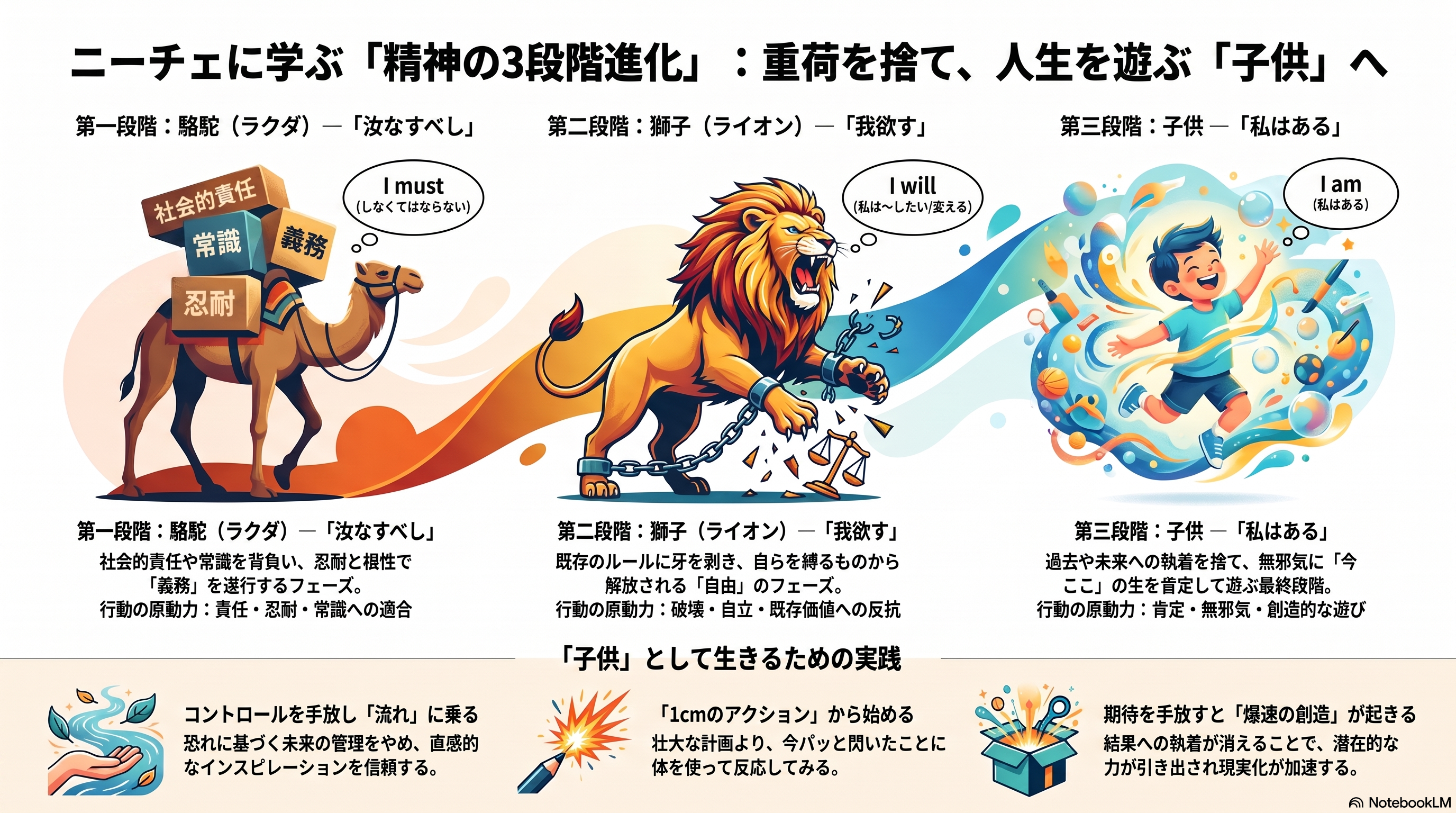
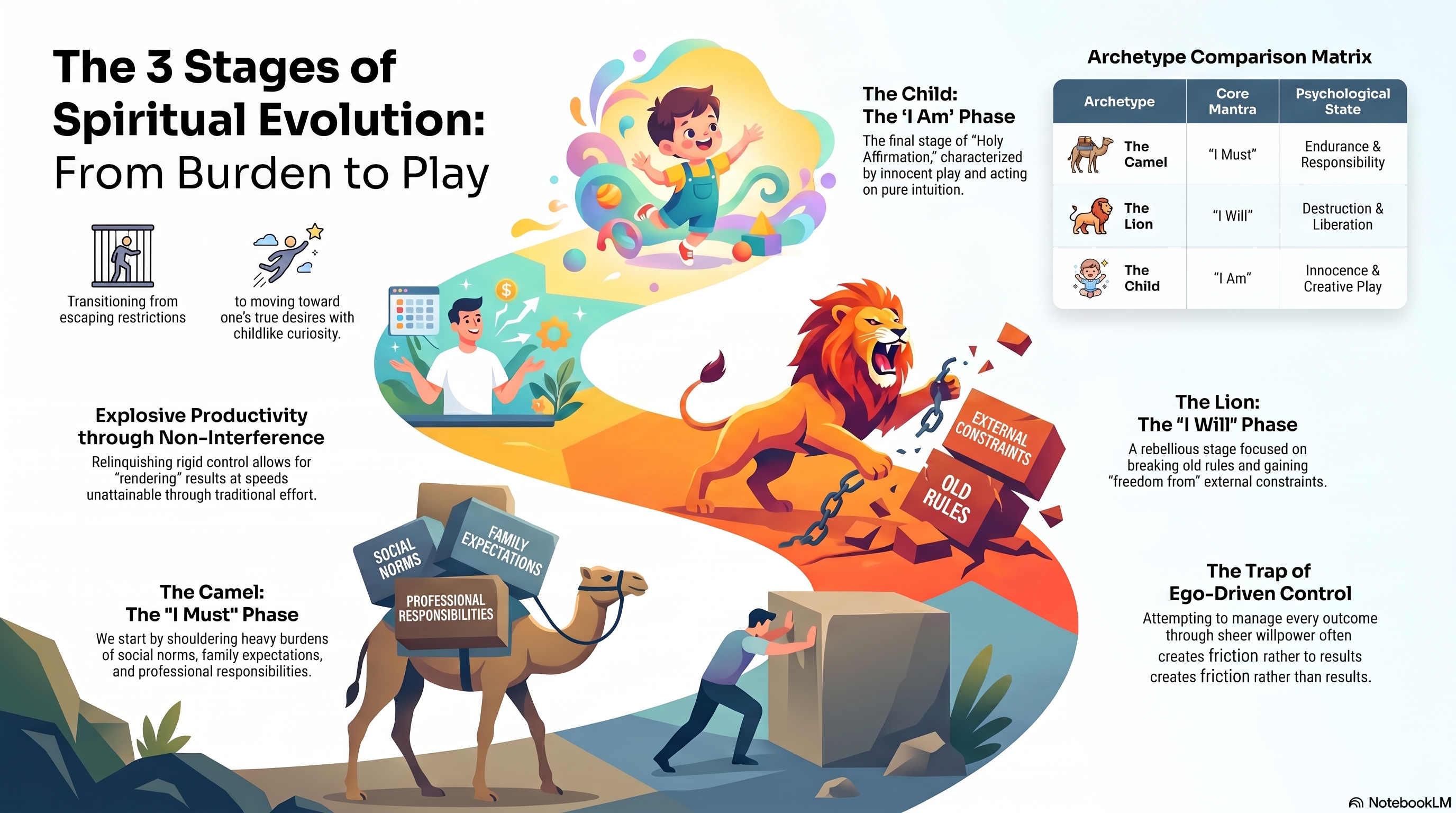
The document categorizes human development into three distinct symbolic phases. Each phase is defined by its core motivation, linguistic signifier, and psychological state.
Comparative Analysis of Spiritual Stages
| Stage | Symbol | Signifier | Psychological State | Objective |
| Stage 1 | The Camel | “I Must” | Endurance/Heavy Burden | Carrying social and personal responsibilities. |
| Stage 2 | The Lion | “I Will” | Rebellion/Destruction | Breaking old rules and seeking “freedom from” constraints. |
| Stage 3 | The Child | “I Am” | Innocence/Play | Spontaneous creation and “freedom to” exist in the flow. |
Detailed Analysis of the Three Stages
1. The Camel: The Burden of Responsibility
The Camel stage is defined by the “I must” mindset. It represents a period of enduring heavy burdens while wandering through a metaphorical desert.
- Characteristics: Reliance on grit, perseverance, and “doing.” It is the phase of conforming to social common sense, career expectations, and family obligations.
- Ego Perspective: This is an ego-driven phase rooted in fear and perceived lack. The ego acts to avoid anxiety or to gain temporary security through achievement.
- Business Context: For a manager, this involves carrying the weight of employee livelihoods, customer satisfaction, and legal obligations.
2. The Lion: The Power of Rebellion
As the Camel grows weary of its burdens, it transforms into a Lion. The Lion seeks to conquer its desert and become master of its own domain.
- Characteristics: The “I will” mindset. It is a phase of “freedom from” (negative liberty)—liberation from the “thou shalt” of the dragon (tradition and values).
- Function: This is a stage of deconstruction and “debugging” the ego’s Operating System (OS). It involves confronting established values and fighting against the majority or the status quo.
- Limitation: While the Lion can destroy old values, it is not yet capable of creating new ones. It is still a reactive state, defined by what it opposes.
3. The Child: The State of Holy Affirmation
The final transformation is into the Child. This is described as a “sacred yes” to life and the world.
- Characteristics: Innocence, forgetting, and a new beginning. The Child acts on pure impulse and intuition rather than external rules or reactive rebellion.
- Freedom to Create: This represents “freedom to” (positive liberty). The struggle is over because there are no longer external enemies or burdens to fight.
- Consciousness Shift: The OS shifts from ego-led to “Being-led” (or Zero Point Field-led). The ego does not “die” but moves to the background, acting as a filter for enjoyment rather than the primary driver of action.
Practical Application: Operating in “Child” Mode
The source provides specific insights into how the “Child” state manifests in practical life and business, often leading to “explosive creation” and rapid results.
The Concept of “1cm Movement”
To enter the flow of the Child state, one should not rely on complex long-term planning or rigid to-do lists.
- Intuitive Action: When an inspiration or impulse occurs, move “1cm”—take the smallest possible physical action toward it.
- Speed of Rendering: This approach can lead to “high-speed rendering” of reality. The source cites an example of writing nine books in a month by following spontaneous interest rather than a fixed schedule.
- Abandoning Control: Rigid techniques like the Pomodoro technique or business KPIs are often bypassed in favor of working until “bored” or “satisfied.”
Management without Micromanagement
A common objection to the “Child” state is the fear of irresponsibility. However, the source argues that reality often functions better when the ego stops trying to control it.
- The Illusion of Control: Efforts to control outcomes (KPIs, manuals, strict supervision) are often defensive reactions of the ego.
- Organic Growth: When leaders relinquish micromanagement, staff may develop skills (such as video editing or social media management) autonomously, often more effectively than when forced by a manual.
- Trusting the Flow: Relinquishing the “responsible” ego-grip allows for a more optimal “rendering” of the business environment.
Key Insights and Quotations
On the Nature of the Ego
“Basically, the ego is an OS based on fear and lack… It does something to escape that fear or lack temporarily.”
On the Transition to the Child State
“The struggle was there, but the enemy to fight wasn’t actually there… it is a phase of playing with pure motives and impulses here and now.”
On the Paradox of Responsibility
“If you really want to protect something, you shouldn’t use ‘protecting’ as an excuse to control it. You must let go and ride the great flow.”
Conclusion
The evolution from the Camel to the Child requires a courageous transition through the Lion’s phase of destruction. By deconstructing the ego’s dependence on fear and control, individuals can reach a state of “Holy Affirmation.” In this state, the boundaries between work and play dissolve, and actions are driven by a natural alignment with the “Zero Point Field,” resulting in a reality that is more creative, efficient, and harmonious.
Why the Ultimate Level of Personal Growth Is Learning to Be a Child Again
In the modern landscape of high-stakes management and relentless career ladders, burnout is often treated as a mere scheduling error—a failure of time management. In reality, it is a metabolic failure of the spirit. Many professionals carry a weight so profound it exhausts the soul long before the workday begins. This “Heavy Burden” is not just a collection of tasks; it is a metaphysical friction caused by living within a system of perpetual “musts.”
To move beyond this exhaustion, we must look toward a roadmap of spiritual evolution. Drawing from the work of Shunsuke Oyama—who bridges the deep pessimism of his favorite philosopher, Arthur Schopenhauer, with the radical optimism of Friedrich Nietzsche—we find a profound architecture for growth. It is found in Nietzsche’s “Three Metamorphoses,” a journey that reveals why the ultimate pinnacle of productivity and leadership is not becoming a more powerful adult, but returning to the innocence of a child.
The First Stage: The Camel and the Weight of “I Must”
The first stage of development is the Camel, defined by the mindset of “I Must” (Shina-kereba-naranai). The Camel is the beast of burden that kneels to receive the heaviest loads: social common sense, the expectations of parents, and the “spirit and guts” (kiai konjo) required to endure the desert of the marketplace.
This phase is governed by what Oyama calls the GOS (Giga/Ego Operating System). In this state, our internal software is programmed by fear and lack. We carry the weight of being the “reliable manager,” the “provider,” or the “eldest son” because we fear that if we let go, our world will vanish. It is a friction-filled game where every action is a reaction to an external demand. While the Camel’s endurance is necessary for discipline, it is ultimately a state of suffering.
“I was in the ‘Camel’ phase for a long time… carrying the employment of employees, the responsibility to customers, and my role as the eldest son. I was playing the game of ‘how things should be,’ carrying all these burdens through sheer willpower. I believed that if I did not sacrifice myself, the world I had built would collapse.”
The Second Stage: The Lion’s Roar of “I Will”
When the spirit can no longer endure the weight of the “Thou Shalt,” it transforms into the Lion. This stage is defined by the mindset of “I Will” (Ichi). The Lion is the spirit of rebellion; it seeks to capture its own freedom and become the master of its own desert.
This is the phase of “Freedom From”—the negative liberty required to break chains. In business, this looks like the entrepreneur quitting a soul-crushing corporate job or the manager dismantling a toxic hierarchy. The Lion turns its teeth against the rules, the “social common sense,” and the controllers.
However, the Lion is inherently limited because it is reactive. It defines itself by what it is fighting against. Because it views the world as a battlefield between the ruler and the ruled, it remains locked in conflict. It can destroy old structures, but it cannot yet create something truly new. It has not yet escaped the gravity of the ego.
The Final Transformation: The Innocence of the Child (“I Am”)
The most counter-intuitive takeaway of this philosophical journey is that the highest evolution is not the Lion, but the Child. This is the state of “I Am” (Aru), characterized by what Nietzsche called “Sacred Affirmation” (Seinaru Koutei).
The Child moves from “Freedom From” to “Freedom To.” In this state, the world is no longer a desert to be endured or a battlefield to be won; it is a place to play with pure impulse. The Child creates because the act of creation is inherently joyful. The ego (the GOS) does not disappear, but it is demoted. It moves to the background, acting as a filter for enjoyment rather than the driver of control. In this state, you realize the “enemy” you were fighting as a Lion was an illusion—a projection of your own internal friction.
“The enemy I was fighting didn’t actually exist… the highest evolution is to return to the innocence of a child playing with pure impulse. When you reach this ‘Sacred Affirmation,’ you no longer need to control the outcome; you simply play with the world as it is.”
The Productivity Paradox: Why Surrender is Faster than Control
We are conditioned to believe that “Child Mode” is irresponsible and would lead to the collapse of our businesses. Shunsuke Oyama’s discovery suggests the exact opposite: Surrender is the ultimate catalyst for speed.
When Oyama transitioned into Child Mode, he experienced what he calls “ultrafast creation.” In a single month, he wrote nine books and completed an English teaching project that had been stagnant for over a decade. This happened because he stopped “trying” to write and instead began “rendering” reality.
In the philosophical context of the “Zero Point Field,” the result already exists. The act of creation in Child Mode is not about building from scratch; it is like “atereko” (dubbing or post-recording). You are simply providing the voice and the movement for a reality that is already trying to manifest.
| Ego-Driven Management (GOS) | Child-Mode Creation (Aru) |
| Foundation: Fear and Lack. | Foundation: Sacred Affirmation. |
| Logic: If-Then conditions (I’ll be happy if…). | Logic: Now-Centered (Everything is already okay). |
| Method: KPIs, manuals, and micromanagement. | Method: Flow, intuition, and “Rendering.” |
| Result: High friction, burnout, and stagnation. | Result: Effortless output and “ultrafast” results. |
Actionable Insight: The “1cm Movement” Rule
To bypass the “Ego OS” and its defense reactions, Oyama proposes the “1cm Movement” rule. This must be distinguished from “Baby Steps.” Baby Steps are often logical, planned parts of a To-Do list—tools of the Camel.
The 1cm Movement is about moving the physical body the exact moment an impulse strikes, without a plan. If you feel a spark to write, you do not check your calendar or set a Pomodoro timer; you move your hand to the keyboard immediately. This tiny physical movement bypasses the ego’s “defense reaction” (the fear of failure or the need for a plan) and allows the Flow (Ryuryuki-gaku) to take over. You act until you are bored, then you stop. By following the wave rather than the schedule, you align yourself with the optimum flow of reality.
Conclusion: Letting Go of the Illusion of Responsibility
The ego’s loudest protest against becoming a Child is the claim of “responsibility.” We tell ourselves that our employees, families, and customers depend on our suffering. We believe that if we stop micromanaging the KPIs, everything will fall apart.
However, the evidence of Oyama’s own company proves that things run better when the ego stops interfering. When he stepped back from his rigid manuals and constant control, a remarkable thing happened: his staff—including international members—spontaneously began to develop new skills. Without being ordered or trained via a manual, they began mastering Canva, editing short-form videos, and managing Instagram marketing with more creativity than any KPI could have demanded.
The “Musts” we carry are often just defense mechanisms of an old Ego OS trying to justify its own existence. By burning away the illusion that your constant control is what keeps the world turning, you don’t become less effective—you become a vessel for a higher level of creation.
Final Reflection: What heavy burden of “Must” are you currently carrying that you are finally ready to burn away, so that you may play as a child again?